Young Leader of the Month
Jacques Kwibuka
286 views
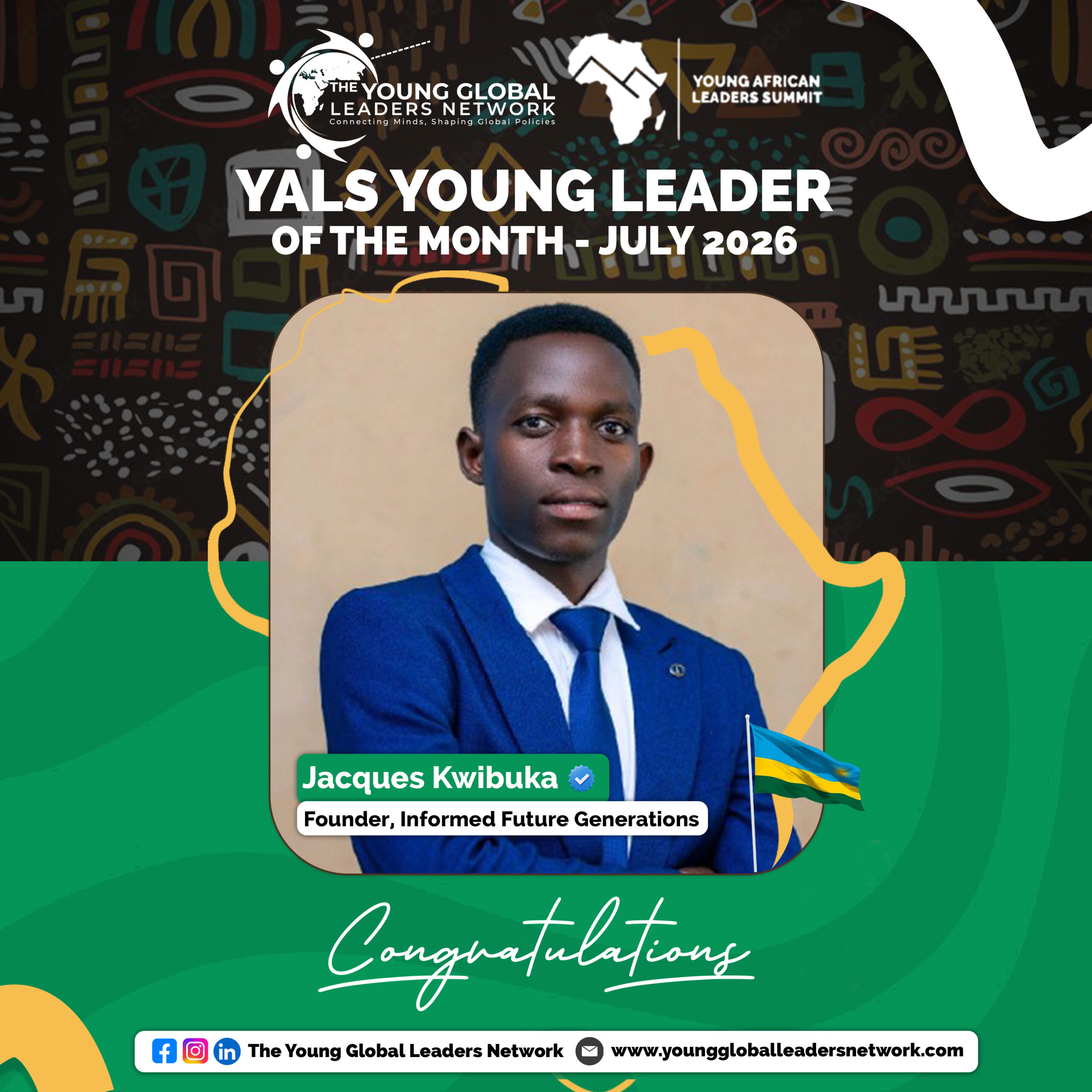
When the Marburg virus struck Rwanda in 2024, the world watched with familiar anxiety. But inside the isolation wards, one young nurse did not wait for instructions from Geneva or Washington. Jacques Kwibuka stepped forward, took command of the evacuation team at the Rwanda Biomedical Center, and moved patients with the precision of a field commander. He was barely out of his undergraduate nursing degree.
That moment, cold, urgent, and unforgiving, was not an accident. It was the culmination of a life spent reading the silent crises that others overlook.
Meet Mr Jacques Kwibuka, the YALS Young Leader of the Month for July 2026. The title is fitting, but it barely captures the weight of what this twenty something Rwandan has already built, dismantled, and rebuilt in the name of a continent that too often waits for saviours from elsewhere.
His story begins not in boardrooms or foreign embassies, but in the uncomfortable spaces between data and despair. While still a nursing student, he watched his peers drift away from the profession, worn down by poor conditions and weaker support. He saw patients receive care that was technically correct but humanly hollow. His response was not to complain, but to organise. He founded the Rwanda Student Nurses Association and co-founded the Nursing and Midwifery Students and Early Career Professionals Network. Today, as president of the association, he has turned it into a national force for professional dignity, arguing that Africa will never achieve universal health coverage until its own health workers are cherished, not expendable.
But his gaze was always wider than the hospital ward. Pouring over epidemiological reports, he noticed a quieter, more stubborn epidemic: teenage pregnancies climbing year after year, HIV stubbornly persisting among adolescents, and mental health disorders rising without a single national safety net for young people. The statistics were not abstract. They were his contemporaries, his neighbours, his future. In 2020, he founded Informed Future Generations, a youth led organisation that does not preach or patronise. It equips young Rwandans with the truth about their bodies, their minds, and their choices. It speaks in Kinyarwanda and English, in villages and WhatsApp groups, because stigma does not respect official languages.
That same analytical clarity now drives his work on a different frontier: the digital one. In partnership with the Young and Resilient Research Centre at Western Sydney University, Mr Kwibuka is coordinating a research project that aims to decolonise digital design. It is a bold, almost audacious ambition to ensure that the platforms used by African children are not just translated versions of Western models, but are built from African realities, with African safety and African agency at their core. It is, in his words, about who gets to decide what safe looks like.
What makes Mr Kwibuka profoundly African, and profoundly global at the same time, is his refusal to specialise in one problem. He is a registered nurse, an MBA and MPPM candidate, a certified consultant, a holder of the Intore cultural titles that root him in Rwandan warrior tradition, and a trained civic educator with military discipline. This is not a scattered CV. It is a deliberate architecture. He understands that poverty, disease, illiteracy, and digital exclusion are not separate crises; they are the same crisis wearing different masks. Leadership, for him, means being fluent in all their languages.
His recognition this month by the Young African Leaders Summit is not a celebration of resume length. It is an acknowledgement of a deeper truth: that the future of global health, education, and governance will not be decided in New York or London. It will be decided in places like Rwamagana, where a young nurse turned a dormitory conversation into a national movement, where a cultural warrior turned self reliance into a lesson in dignity, where a researcher turned colonial digital models into a call for liberation.
Jacques Kwibuka does not speak of himself as a hero. He speaks of duty. But in a world that too often confuses performance with purpose, his example is a quiet detonation. He reminds us that the most powerful leaders are not those who seek the microphone, but those who spend their twenties reading reports, organising peers, and standing between their people and preventable death.
“Leadership is not about titles,” he says. “It is about analysing the cracks in your community and having the courage to fill them yourself.”
That is the African leadership the world needs to see. Not the kind that waits for permission. The kind that builds, evacuates, heals, and codes all before breakfast.
And it is already here
Nominate an outstanding young African leader for the YALS Young Leader of the Month spotlight.